Spending More Time on Coffee to Get More Time Back: The Qahwa Math That Actually Works
Let's do some quick math. Your espresso takes 30 seconds. Your cold brew is grab-and-go. Your drive-through latte costs you maybe four minutes if the line's short. By every conventional measure, you are winning the morning coffee efficiency race.
So why do people who brew qahwa the traditional way — a process that takes anywhere from 20 to 30 minutes of active attention — consistently report feeling more focused, less reactive, and better equipped to handle the chaos of a full workday?
The answer isn't mystical. It's actually pretty well-supported by research. But to understand it, you have to be willing to rethink what "efficient" even means.
The Problem With Fast Coffee Isn't the Coffee
Here's what typically happens when you grab an espresso or a quick drip cup on your way out the door: you drink it in motion. You're already in reactive mode — checking your phone, scanning your inbox, mentally rehearsing your first meeting. The caffeine hits a brain that's already spinning.
Researchers studying morning routines and cognitive performance have found something interesting: the transition from sleep to high-demand thinking isn't just biological. It's behavioral. How you spend the first 30 to 60 minutes of your morning sets a kind of cognitive tone for the hours that follow. Rush that window, and you're essentially starting a race mid-sprint.
Qahwa doesn't let you rush. That's not a bug — it's the whole point.
What Actually Happens During Those 25 Minutes
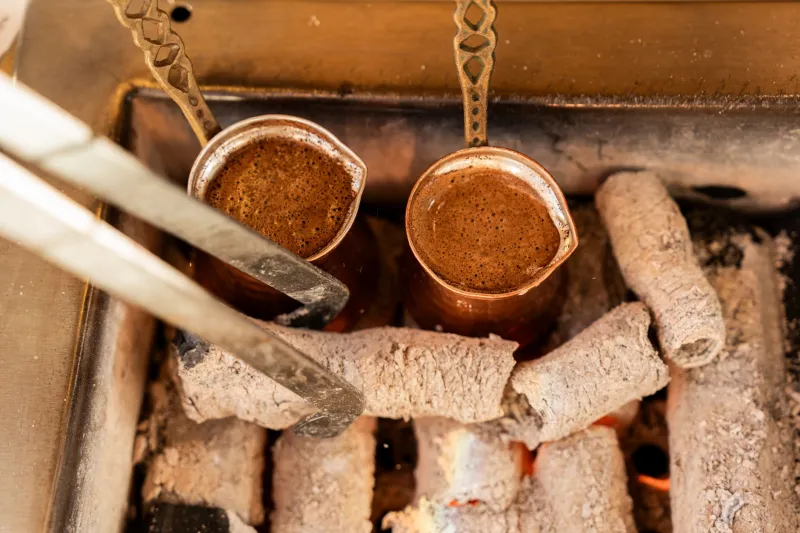
Traditional qahwa preparation is a multi-step process. You're measuring lightly roasted beans, grinding them coarsely, simmering water in a dallah (the iconic long-spouted brass or stainless pot), adding ground cardamom, sometimes saffron, sometimes dried rosewater. You're watching the pot. You're adjusting heat. You're waiting.
That waiting is doing something to your brain.
Neuroscientists use the term "default mode network" to describe what happens when your brain isn't focused on a specific task. Far from being idle, this network is where your brain consolidates information, processes emotions, makes intuitive connections, and essentially prepares you for complex thinking. It's the mental equivalent of a deep breath before a big lift.
A rushed morning suppresses this. A slow, sensory-engaged ritual like qahwa brewing actively encourages it.
You're not zoning out during those 25 minutes. You're giving your brain the quiet it needs to actually show up.
The Decision Quality Dividend
Here's where the time math starts to make sense.
Research on decision fatigue — the well-documented phenomenon where the quality of our choices degrades as the day goes on — suggests that how mentally fresh you are at the start of the day has an outsized impact on your best thinking. Studies from Columbia University and others have shown that judges, executives, and professionals across industries make their sharpest decisions earlier in the day, and that cognitive preparation (not just caffeine) is a significant factor.
Qahwa drinkers who go through the full ritual aren't just getting caffeine. They're arriving at their first real decision of the day — whether that's a work email, a parenting call, or a business negotiation — having already spent 25 minutes in a calm, focused, sensory-present state. Their baseline is different.
One bad reactive decision in the first hour of your workday can cost you hours of cleanup. A few of those per week? You're hemorrhaging time. The qahwa ritual, in this light, isn't costing you 25 minutes. It's potentially buying back far more.
Why This Isn't Just About Mindfulness
It's tempting to file this under the general "mindfulness is good" category and move on. But qahwa's efficiency case is more specific than that.
The ritual has structure. You're not just sitting quietly — you're doing something with your hands, following a sequence, engaging your senses (the smell of cardamom warming, the sound of water simmering, the visual of the brew deepening in color). That combination of structured physical activity and sensory engagement is particularly effective at quieting the kind of anxious, anticipatory thinking that makes mornings feel chaotic before they've even started.
In behavioral psychology, this is sometimes called "productive displacement" — engaging in a low-stakes, absorbing task that prevents rumination without requiring high cognitive output. Athletes use it before competition. Surgeons often have pre-procedure rituals. Qahwa drinkers in the Gulf states have been doing it for generations without needing a name for it.
The Social Efficiency Angle Nobody Talks About
In traditional qahwa culture, the brewing ritual is also a social one. You brew for guests. You pour for family. The act of preparing and serving qahwa is, in itself, a form of relationship maintenance — one that many Americans outsource to restaurant reservations, awkward happy hours, or sporadic text messages.
When you build a qahwa ritual into your morning, even a solo one, you're also building a framework that scales to connection. Having someone over for qahwa is a low-pressure, high-meaning gesture. It's not dinner. It's not a big production. It's 25 minutes and a pot of something warm and fragrant. The ritual handles the awkwardness; all you have to do is show up.
Relationship maintenance, done consistently and without drama, saves enormous amounts of social and emotional energy over time. Again — the math works out.
How to Actually Try This (Without Overhauling Your Morning)
You don't have to go full dallah on day one. Here's a reasonable entry point:
Start with the time block. Set aside 20 minutes before you look at your phone. That's it. Just the block.
Add the sensory element. Brew something that requires attention — even a simple cardamom-spiced pour-over gets you partway there. The point is engagement, not perfection.
Protect it like a meeting. This is the part most people skip. The ritual only works if it's consistent. Three days a week of actual protection beats seven days of good intentions.
Notice the afternoon. Don't evaluate the ritual by how you feel at 8 a.m. Pay attention to your 2 p.m. focus, your decision quality in a mid-afternoon meeting, how reactive or grounded you feel when something unexpected lands in your lap.
That's where qahwa's time investment pays its dividends — not in the morning, but in the hours that follow.
The Oldest Productivity Hack in the Room
Modern productivity culture loves a new framework. But the qahwa ritual has been field-tested across centuries, continents, and cultures. It survived the Ottoman Empire, the Silk Road, the rise of instant coffee, and the third-wave espresso craze. It's still here.
Maybe that's because the people who practice it keep discovering the same thing: you don't save time by rushing your morning. You save time by arriving at your day ready to actually handle it.
Twenty-five minutes of slow, fragrant, intentional brewing. The rest of the day, spent sharper.
That's not a paradox. That's just good math.


