When a Dallah Is Worth More Than a Diamond: The Heirloom Tradition Hidden Inside Middle Eastern Coffee Culture
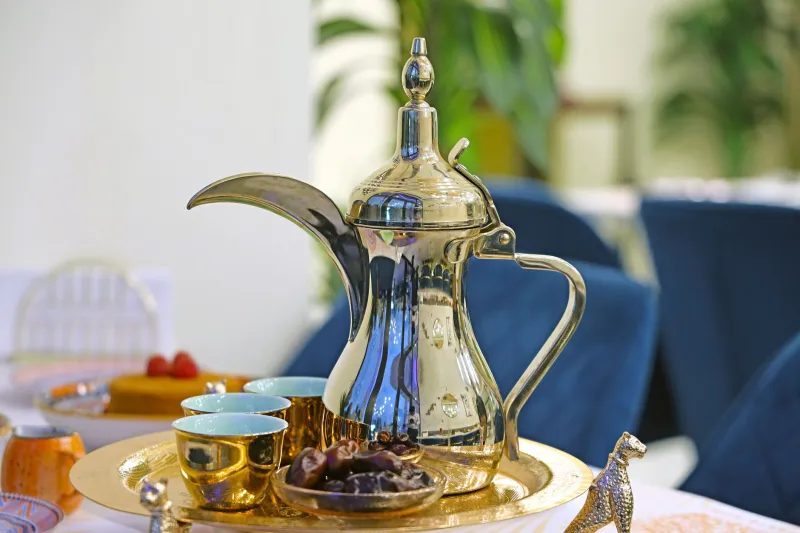
There's a particular kind of inheritance that doesn't show up in a will. It doesn't get appraised, insured, or listed in an estate sale catalog. It lives in a copper dallah with a dented spout, or in a grandmother's handwritten note about how much cardamom is too much. It passes between hands the way knowledge passes between generations — quietly, deliberately, and with enormous weight.
In the Middle East, that weight has a name. And for centuries, it had a place in the dowry.
More Than Gold: What the Dowry Was Really Saying
The traditional Middle Eastern dowry — the mahr in Islamic tradition, or the broader jihaz in many Arab cultures — was never just a transaction. Yes, there were practical elements: jewelry, textiles, household goods. But nested inside those objects was something harder to price: a signal of status, readiness, and family pride.
Qahwa preparation knowledge was part of that signal.
A young woman who could brew qahwa correctly — who understood the precise ratio of green coffee to saffron, who knew how long to roast over an open flame, who could read a guest's cup and refill it before it was empty — was not simply a good host. She was a keeper of tradition. She was someone a family could trust to carry a culture forward.
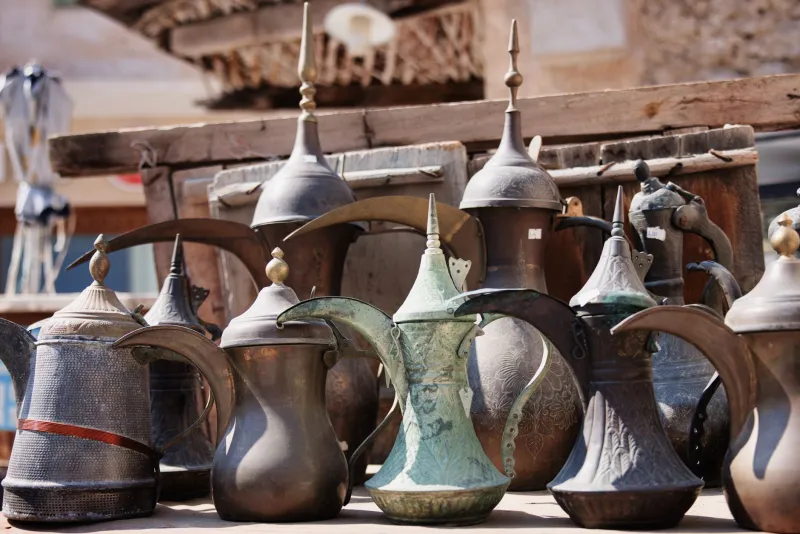
And the equipment she brought with her? That mattered too. A well-crafted dallah wasn't cheap. A full set of finjans — those small, handleless porcelain cups — represented real investment. Families who sent their daughters into new households with quality coffee vessels were saying something specific: we take this seriously, and so should you.
That message was understood without being spoken. In a culture where hospitality is a moral value, not just a social nicety, coffee equipment was a statement of character.
The Knowledge Half of the Gift
Here's the part that gets lost when we reduce dowries to objects: the skill was the real inheritance.
Recipes for spice blends weren't written down — they were whispered. A mother would spend months before a wedding making sure her daughter had memorized the family's qahwa formula. The exact proportion of cardamom. Whether to add cloves. How much saffron, and when. The particular wrist motion that kept the grounds from clouding the pour.
This knowledge was guarded. It distinguished one family's coffee from another's. At a wedding, at a funeral, at a business negotiation, the quality of the qahwa served was a direct reflection on the household. Guests noticed. They talked.
So when a mother taught her daughter to brew, she wasn't just passing on a recipe. She was handing over a piece of the family's reputation and saying: don't drop it.
That's a different kind of heirloom than a piece of jewelry. A ring sits in a box. Knowledge has to be practiced to survive.
What Americans Are Starting to Figure Out
The formal dowry tradition isn't something most American families are looking to adopt wholesale — and that's fine. But something quieter and genuinely interesting is happening at the intersection of Middle Eastern coffee culture and American family life.
Families who've discovered qahwa — whether through travel, through a neighbor, through a growing interest in non-Western food traditions — are starting to treat coffee equipment differently. Not as a commodity to be upgraded every few years, but as something worth keeping. Worth giving.
A dallah that belonged to a grandmother. A mortar and pestle used for grinding spices since before anyone can remember. A small ceramic serving set brought back from a trip to Amman or Dubai. These objects are finding their way into American homes not as decorations, but as working pieces with stories attached.
And the stories are the point.
One woman in Dearborn, Michigan — part of one of the largest Arab American communities in the country — described receiving her mother-in-law's dallah as more meaningful than any other wedding gift. "It wasn't new," she said. "It wasn't expensive by anyone's standards. But every time I use it, I think about her. I think about what she was trying to tell me about this family."
That's the logic of the traditional qahwa dowry translated into a contemporary American context. The object carries the relationship. The skill carries the culture.
Why This Matters Now
We live in an era that's deeply confused about what's worth keeping. We upgrade constantly. We rent instead of own. We stream instead of collect. The average American household moves eleven times in a lifetime. Heirlooms are inconvenient.
And yet — there's a real hunger for objects that mean something. For practices that connect us to something older than last year's trend. The explosion of interest in slow food, in craft, in handmade goods isn't random. It's a response to a culture that moves so fast it struggles to hold onto anything.
Qahwa fits that hunger in a specific way. It's not just a beverage you can romanticize from a distance. It's a practice that requires your hands, your attention, your time. You can't make good qahwa while scrolling your phone. You have to be present for it.
And when you make it with equipment that belonged to someone you loved, or with a recipe you learned from someone who learned it from someone else — that presence has a dimension most modern rituals simply don't offer.
Passing It Forward
You don't need a wedding to make this work. The logic of the qahwa dowry — the idea that coffee knowledge and coffee equipment are worth inheriting — applies to any intentional act of passing something down.
Teach a teenager in your family how to brew qahwa from scratch. Not from a pod, not from a mix — the real thing, with green beans and a dallah and whatever spice combination your household has landed on. Let them make mistakes. Let them adjust. Give them something to practice until they don't need to think about it anymore.
Then, when the time is right, give them the dallah.
That's not a dowry. It's something better: a tradition you built yourself, grounded in something ancient, handed to someone who'll carry it further than you can see.
At Qahwaji, we believe every cup tells a story. The most powerful stories are the ones that keep getting retold — in new kitchens, by new hands, with the same care that started them.