Sleeping Through the Night Again: What Arab Coffee Culture Gets Right That American Espresso Culture Gets Dead Wrong
Let's be honest about something. A lot of Americans are running on a cycle that doesn't actually work: wake up wrecked, hammer a double espresso, crash by two in the afternoon, grab another coffee to push through, and then spend half the night wide awake wondering why their brain won't shut off. Repeat forever.
What if the problem isn't coffee itself — but the way we've been drinking it?
Traditional qahwa, the amber-hued ceremonial coffee at the heart of Gulf and Levantine culture, has been consumed daily for centuries by people who don't seem to share our collective sleep crisis. That's not a coincidence. There's real science behind why, and it's worth paying attention to.
The Caffeine Gap Nobody Talks About
Here's the first thing to understand: qahwa and espresso are not the same drink wearing different clothes. A standard double espresso clocks in somewhere between 120 and 180 milligrams of caffeine. A traditional small cup of qahwa — served in a handleless finjan — typically contains somewhere between 30 and 60 milligrams, depending on the beans used and how long they've been roasted.
And that roast matters more than most people realize. Traditional qahwa uses lightly roasted green or pale-gold coffee beans, sometimes called "white coffee" in certain regional traditions. Light roasting preserves more of the bean's aromatic compounds but actually delivers less caffeine than the dark, oily roasts Americans tend to associate with strong coffee. The darker the roast, the more the bean structure breaks down and the more caffeine becomes readily extractable. So that "intense" espresso roast you're grinding every morning? It's hitting harder biochemically than it needs to.
Sleep researchers have consistently pointed to caffeine's half-life as a major disruptor of American sleep patterns. Caffeine has a half-life of roughly five to seven hours in most adults — meaning half of that afternoon latte is still circulating in your bloodstream at midnight. A lower-dose morning qahwa, consumed early and slowly, clears your system with significantly less interference by the time your head hits the pillow.
What the Spices Are Actually Doing
Cardamom is the defining spice of qahwa, and it's doing more than adding flavor. Research into cardamom's bioactive compounds — particularly its volatile oils like cineole and limonene — suggests the spice has mild adaptogenic and calming properties. It doesn't sedate you, but it takes the jagged edges off stimulation. Some traditional preparations also include saffron, cloves, and dried rosebuds, each with their own documented effects on mood and stress response.
Dr. Layla Nassir, a sleep medicine physician based in Dearborn, Michigan, who grew up drinking qahwa with her Lebanese grandmother, puts it plainly: "When I compare how I feel after a traditional qahwa versus an Americano, the difference is real. The qahwa gives me alertness without the spike. And I've noticed that patients from Arab backgrounds who maintain traditional coffee habits often report better sleep quality than those who've fully adopted American coffee culture. It's not scientific data from my practice — it's clinical observation — but it's consistent enough that I started paying attention."
She's not alone in that observation. A growing number of integrative medicine practitioners are pointing to the spice matrix in traditional qahwa as a meaningful modifier of the coffee experience — something that essentially softens the physiological impact while preserving the ritual and the warmth.
The Ritual Is the Medicine
Here's where it gets interesting, because the spices aren't the whole story. The way qahwa is prepared and consumed is itself a kind of regulation mechanism.
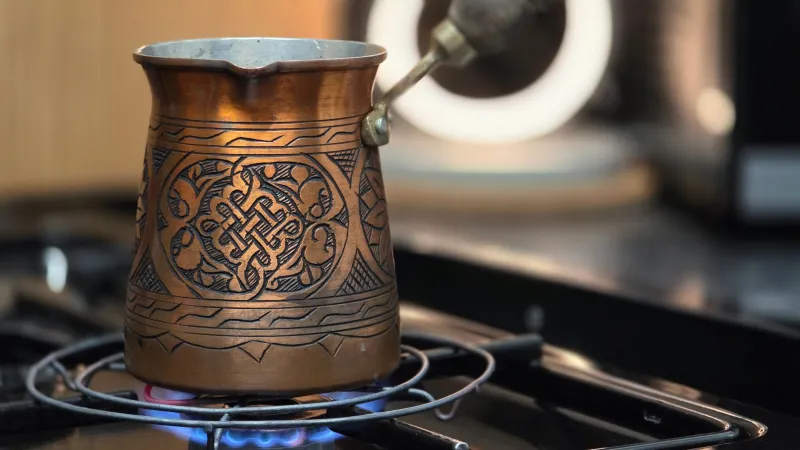
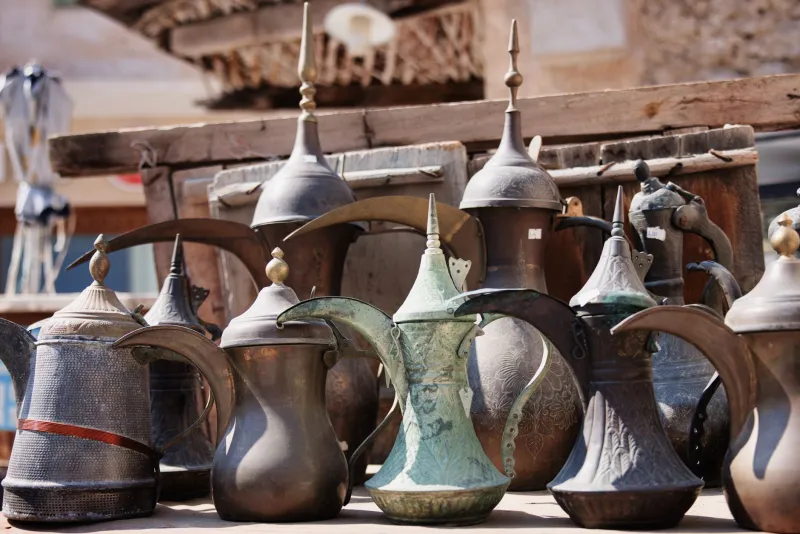
In traditional qahwa culture, coffee is not something you inhale between tasks. It's something you sit with. The preparation — grinding light beans in a wooden mortar, simmering them slowly in a dallah pot, adding spices in careful sequence, pouring into small cups with deliberate attention — takes time. That time is not wasted. It's physiologically productive.
The act of slow, intentional preparation triggers what researchers call the parasympathetic nervous system response. Your breathing slows. Your cortisol levels begin to drop. By the time you actually drink the coffee, your body is already in a calmer state — which means the caffeine integrates differently than it would if you'd slammed it in a parking lot between meetings.
Amir Al-Rashidi, a software engineer in Austin who emigrated from Kuwait a decade ago, describes it this way: "In Kuwait, my grandfather would make qahwa every morning and it was never rushed. We'd sit, we'd talk, the coffee would come. Here, I watched my coworkers chug coffee standing up. I tried doing that for a while and my sleep was terrible. When I went back to making qahwa the traditional way — even just for myself — something shifted. It's not just the drink. It's the whole thing around it."
What Americans Can Actually Do About This
You don't have to abandon coffee entirely, and you don't have to overhaul your life. But there are some concrete, practical shifts that can genuinely move the needle.
Switch your morning brew. Try replacing your first coffee of the day with a small cup of traditionally prepared qahwa. You can source lightly roasted Arabian coffee beans from specialty importers online. Brew it in a small saucepan with a pinch of ground cardamom, a few saffron threads if you want the full experience, and serve it in a small cup. Sip slowly.
Set a caffeine cutoff. This applies to any coffee habit, but it's especially easy to honor if you're drinking smaller, lower-caffeine cups. Aim to stop consuming caffeine by 1 or 2 p.m. to give your system time to clear before sleep.
Use the preparation as a transition ritual. Whether you're moving from morning into work, or from work into evening, the act of making qahwa slowly can serve as a reset — a few minutes of deliberate presence that signals a gear change to your nervous system.
Respect the cup size. Traditional qahwa is served in small portions for a reason. Resist the urge to scale up. The ritual works partly because the quantity is modest. A 12-ounce qahwa defeats the purpose.
An Ancient Answer to a Modern Problem
The American sleep crisis is real. According to the CDC, more than a third of U.S. adults regularly don't get enough sleep. Coffee culture — specifically the high-dose, high-speed, anytime-anywhere version we've normalized — is a contributing factor that most people don't examine closely enough.
Qahwa isn't a cure. But it's a different model, one that has sustained entire cultures through centuries of mornings without producing the kind of stimulant dependency and sleep debt that defines so many American lives right now.
Sometimes the oldest approach turns out to be the most sophisticated one. And sometimes sleeping better is as simple — and as complicated — as slowing down the way you make your coffee.