What the Foam Knows: The Lost Art of Reading Qahwa Before You Drink It

Most of us glance at our coffee for about half a second before we drink it. Maybe we notice if the barista drew a little leaf in the latte foam. Maybe we don't notice anything at all. We're already reaching for our phones.
But somewhere across the Atlantic, in the coffee houses and family majlis of the Arabian Peninsula, Yemen, and the Levant, people have spent centuries doing something entirely different. They look at the cup. Carefully. Intentionally. With the kind of focused attention that most of us reserve for spreadsheets or traffic.
They're reading the foam.
A Tradition Older Than Your Favorite Roaster
The practice goes by different names depending on where you are. Some call it a form of tashayyum — a word that loosely translates to reading omens or signs in natural things. Others describe it more practically as a master brewer's quality check, a way of assessing whether the qahwa was prepared correctly, whether the beans were fresh, whether the spices were properly balanced.
Either way, the underlying skill is the same: a trained eye reading the surface of the coffee to understand what's happening beneath it.
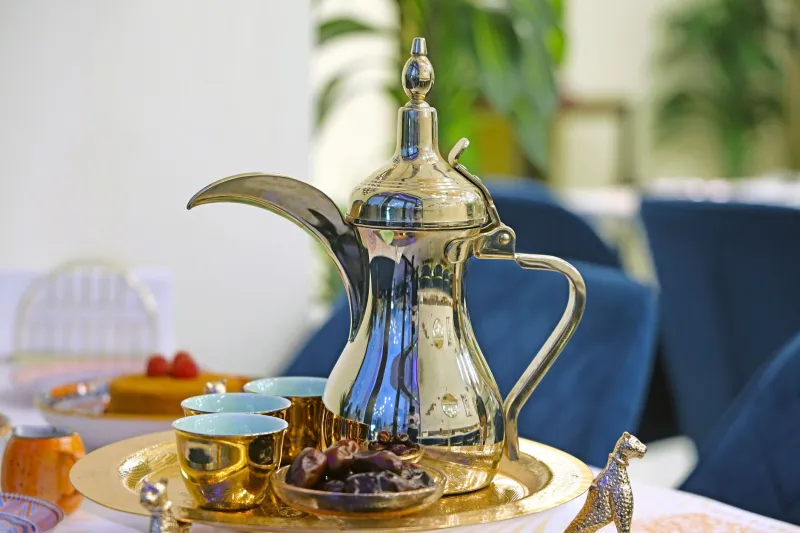
Qahwa masters — the qahwajis who gave this site its name — developed this visual literacy over generations. The color of the foam. Its density. Whether it held together or broke apart quickly. Whether it formed in the center of the cup or crept to the edges. All of it meant something to someone who knew how to look.
This wasn't superstition for its own sake. It was accumulated knowledge, passed from brewer to brewer, about what a well-made cup of qahwa actually looks like.
What the Foam Actually Tells You
Here's the thing that makes this practice genuinely fascinating from a modern perspective: the foam doesn't lie.
When you brew qahwa — or any coffee prepared without paper filtration — the surface of the liquid becomes a kind of report card. The oils, the proteins, the carbon dioxide released from freshly roasted beans, the way the spices interact with the liquid — all of it rises to the top and shows itself.
A thick, golden-tinged foam that holds its shape? That's a sign of fresh beans, proper heat, and a brew that wasn't rushed. The oils are intact. The aromatics are alive. A qahwa master would look at that cup and feel confident before a single drop touched their lips.
A thin, patchy foam that breaks apart almost immediately? That tells a different story. The beans may be stale. The water might have been too hot, scalding the grounds rather than coaxing them. The spice ratio could be off, disrupting the natural emulsification process. A practiced eye catches all of this before the cup ever reaches a guest.
When you understand that context, the act of reading the foam stops looking like mysticism and starts looking like science — centuries-old empirical knowledge dressed in the language of the culture that developed it.
The Mood Reading Part (Yes, Really)
Now here's where it gets interesting for the skeptics in the room.
Beyond quality assessment, some qahwa traditions held that the foam could reflect something about the moment — the energy of the gathering, the state of mind of the person being served, even the general tone of the day ahead. This is the part that tends to make Western audiences uncomfortable, because it sounds like coffee astrology.
But sit with it for a second before you dismiss it.
A skilled qahwa master wasn't reading the foam in isolation. They were reading the foam and the person holding the cup and the room and the time of day and the quality of their own preparation that morning. The foam was one data point in a much larger act of presence and attention.
When a master said the foam looked "unsettled" and suggested the day ahead might require patience, they weren't making a supernatural claim. They were modeling the kind of mindful observation that most of us have completely abandoned. They were paying attention to everything at once and offering an interpretation.
That's not so different from what a good therapist does, or a thoughtful friend, or honestly — a really excellent barista who notices you seem stressed and asks if you want your usual or something different today.
Bringing This Into Your Kitchen
You don't need to become a divination expert to take something real from this tradition. What you need is to slow down enough to actually look at your coffee.
If you're brewing qahwa at home — or even if you're making a pour-over or French press — try this: before you drink, pause for ten seconds and look at the surface. What do you see? Is there foam? What color is it? Does it hold or does it disappear almost immediately?
If you're using whole beans you ground fresh this morning, you'll likely see a richer, more active surface than if you're working through a bag that's been open for three weeks. That's real information. The foam is telling you something about the quality of what you're about to drink.
Then take it one step further. Ask yourself how you feel in this moment. Are you rushed? Calm? Anxious about something? The qahwa masters understood that the act of reading the cup was also an act of reading yourself. The two were never really separate.
Why This Matters in 2025
We live in a culture that has turned coffee into either a productivity tool or an aesthetic prop. It's the thing in the to-go cup you drink while answering emails, or it's the photogenic flat white you post before it gets cold. Neither version invites you to actually be present with it.
The qahwa tradition of foam reading is a corrective to both of those habits. It asks you to stop. To look. To notice. To bring the same quality of attention to your morning cup that you'd bring to something you consider genuinely important.
That's not a small ask in 2025. But it might be exactly what most of us need.
The foam has been trying to tell us something for centuries. We just haven't been paying close enough attention to hear it.